
By Cameron Bradshaw September 21, 2026
To buy a luzerne county liquor license, most restaurant or bar buyers must locate an existing transferable license, negotiate its private purchase price, and obtain Pennsylvania Liquor Control Board approval. PLCB transfer fees are separate from the seller’s price. Timing depends on transfer type, investigation, municipal approval, premises readiness, financing, objections, and other required approvals.
For a Hazleton restaurant buyer, the licensing application is only one part of the transaction. The larger challenge is often finding the correct license class at an acceptable price, determining whether it can reach the intended premises, protecting the purchase with appropriate contingencies, and coordinating that process with a lease, construction, financing, staff hiring, inspections, inventory, and payment systems.
Pennsylvania does not operate like a state where every qualified restaurant simply pays a posted fee for a newly created full-liquor license.
The Commonwealth limits many retail licenses through a quota system. In counties already over quota, including Luzerne County, an incoming hospitality operator normally looks to the transfer market or, in some circumstances, a PLCB auction rather than expecting a routine new restaurant license.
That distinction changes how a restaurant acquisition should be budgeted. A seller may ask tens of thousands of dollars for the license itself, while the PLCB charges hundreds of dollars for the regulatory transfer application. Those numbers represent entirely different things.
Luzerne County Liquor License Quick Reference
- Licensing authority: Pennsylvania Liquor Control Board, or PLCB.
- Quota system: Generally one retail liquor license per 3,000 county inhabitants, with a separate one-per-3,000 municipal benchmark relevant to intermunicipal transfers. Quotas are recalculated after the decennial census.
- Luzerne County status: The PLCB’s December 31, 2025 retail-license data reports a 2020 population of 325,594, 508 Restaurant Liquor licenses and 14 Eating Place Retail Dispenser licenses, plus other exempt or differently treated classes. That inventory is far above the statutory benchmark for routine new quota issuance.
- Common restaurant class: An R Restaurant Liquor License is generally the class evaluated for a public restaurant seeking spirits, wine and malt-beverage privileges.
- Private purchase price: Negotiated between buyer and seller; the PLCB expressly says private license sales are not tracked by the Board.
- Current transfer filing fees: As of the PLCB’s September 2026 schedule, person-to-person transfer $650; place-to-place transfer $550; double transfer involving both a new owner and new premises $700. Special surcharges may apply in particular prior-approval situations.
- Typical timeline: The PLCB currently publishes no single guaranteed transfer-processing period. Covered intermunicipal-transfer municipal decisions have a statutory local process; real transactions should be planned in months rather than around a guaranteed approval date.
- Municipal hearing: Particularly important for an intermunicipal transfer into a municipality already at or over its municipal quota. Written municipal approval must be adopted at a public meeting before the PLCB can complete that transfer.
- RAMP: Establishment certification is generally voluntary, although certain licensees can be required to obtain it; separate manager/server training obligations can apply.
- Renewal: Luzerne County is PLCB District 8. District 8 renews in even-numbered years and validates in odd-numbered years; the current cycle lists July 2 as the filing deadline and August 31 as expiration.
The PLCB’s current licensing portal, license search and transfer resources are available through its official licensing page.
Luzerne County Liquor License: How the Purchase and Transfer Process Works
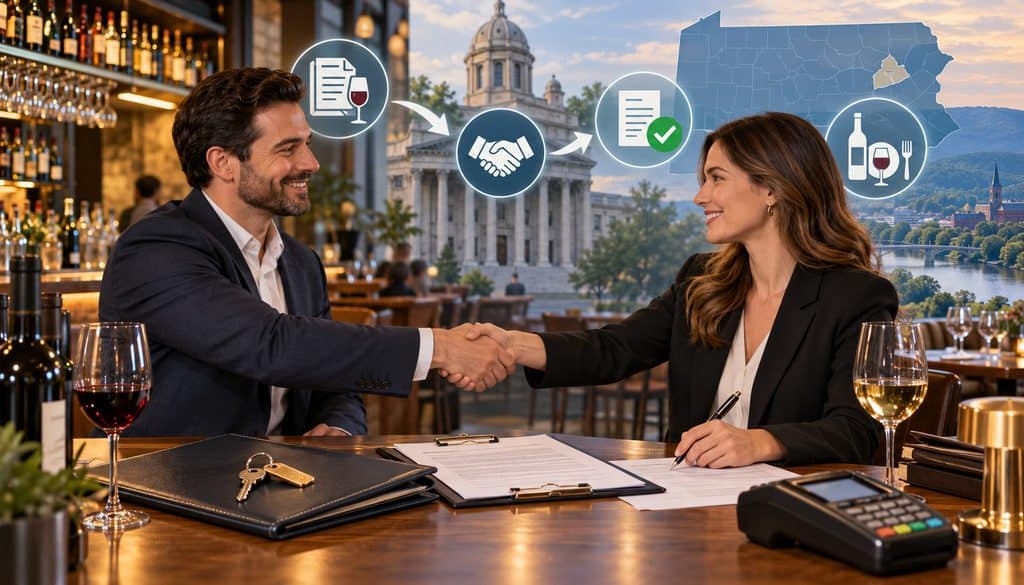
How do you buy a liquor license in Luzerne County? First determine the license class your concept requires, identify a license that can legally reach the intended municipality and premises, verify its status, negotiate a conditional purchase agreement, file the appropriate transfer application through PLCB+, complete the required investigation and local steps, prepare the premises, and wait for final approval before selling alcohol.
Pennsylvania recognizes several ways a license can change hands or locations. A person-to-person transfer changes ownership while keeping the same licensed premises. A place-to-place transfer moves a license owned by the same licensee to another approved premises. A double transfer changes both the owner and the premises.
A buyer acquiring an operating Hazleton restaurant together with its existing license may therefore have a different application than an entrepreneur buying a license from another operator and moving it into a newly renovated storefront.
The commercial transaction and regulatory transfer should not be confused. Signing a purchase agreement can establish contractual rights between buyer and seller. It does not itself make the buyer a PLCB licensee or authorize alcohol sales.
A practical sequence is:
- Define the restaurant, bar, club or hospitality concept.
- Identify the required license class.
- Verify the proposed municipality and premises.
- Review county and municipal quota conditions.
- Locate a transferable license.
- Verify its number, ownership, class and current status.
- Investigate its compliance and safekeeping history.
- Determine whether the transaction is person-to-person, place-to-place or a double transfer.
- Determine whether an intermunicipal transfer is involved.
- Negotiate the license price subject to appropriate regulatory and premises contingencies.
- Coordinate financing and escrow arrangements.
- File through PLCB+ and respond to licensing investigators.
- Complete required municipal proceedings.
- Continue the separate zoning, building, health and construction workstreams.
- Complete required premises approval and licensing conditions.
- Close the transaction as structured by the parties.
- Begin alcohol sales only once the license and all other required approvals are effective.
Pennsylvania Liquor License Quota: Why Scarcity Changes the Price

The Pennsylvania liquor license quota is the reason a restaurant license can have substantial private-market value.
Pennsylvania generally allows one qualifying retail license for every 3,000 county inhabitants, with quota figures updated after the federal decennial census. The PLCB’s current retail liquor license quota guidance also explains how over-quota counties, grandfathered licenses, private transfers, and municipal quotas interact.
Restaurants, eating places and clubs are generally subject to quota restrictions, although the law contains exempt categories such as hotels, certain public venues, airports and several other specialized license types.
The quota should not be interpreted as a command forcing the PLCB to cancel licenses whenever population falls or a county has too many historical licenses. Pennsylvania has numerous grandfathered licenses dating from before the current quota system.
The PLCB explains that most counties therefore have more licenses than today’s quota would otherwise permit. Existing licenses may continue and be renewed even while routine new issuance is restricted.
How does Pennsylvania’s liquor-license quota work?
Pennsylvania generally limits qualifying retail liquor licenses to one per 3,000 county residents. In an over-quota county, a new restaurant normally must obtain an existing transferable license rather than receive a newly issued quota license.
A separate municipal one-per-3,000 benchmark can require local approval before an intermunicipal transfer is allowed.
Luzerne County is substantially over the benchmark
The PLCB’s December 31, 2025 retail-license report lists Luzerne County’s 2020 census population as 325,594. The same report lists 508 R licenses and 14 E licenses, before counting clubs and multiple specialized or exempt classes.
At one qualifying license per 3,000 inhabitants, 325,594 residents produce a benchmark of roughly 108 whole licenses. Comparing that benchmark with hundreds of existing R and E licenses makes the practical conclusion straightforward: Luzerne County is not an environment in which a buyer should plan around easy routine issuance of a brand-new quota R license.
That is why an operator searching for a luzerne county liquor license encounters a resale market.
The official quota framework can be reviewed directly through the state’s current guidance.
Why scarcity affects private-market value
A transferable license can have value because the government limits how many licenses exist while restaurants, bars and investors continue competing for them.
Market price can also be influenced by factors such as:
- license class;
- municipality and possible transfer path;
- whether the license is active or in safekeeping;
- seller urgency;
- local restaurant development activity;
- whether a qualified buyer needs a license immediately;
- compliance or citation history;
- financing availability; and
- whether a proposed premises creates additional regulatory uncertainty.
Those are market considerations, not a PLCB pricing formula.
Table 1: Quota and Transfer Concepts
| Issue | Who Controls It | Business Impact |
| County quota | Pennsylvania law / PLCB administration | Limits routine issuance of quota licenses |
| Municipal quota | Pennsylvania law plus receiving municipality | Can trigger local approval for an intermunicipal transfer |
| Transfer approval | PLCB | Determines whether proposed ownership/premises transfer is approved |
| Private sale price | Buyer and seller | Determines acquisition cost of the license |
| Transfer filing fee | PLCB | Government application cost |
| Zoning / occupancy | Local authorities | Determines whether premises may legally operate as proposed |
The PLCB also says that, as a general rule, liquor licenses cannot be transferred between counties. A buyer who finds an attractive license in another Pennsylvania county therefore should not assume it can simply be imported into Hazleton.
R, E, and C Licenses: Which One Does Your Business Need?
License class should be settled before serious price negotiations.
R — Restaurant Liquor License
An R license is the class most commonly associated with a public restaurant or bar seeking to sell liquor, wine and malt or brewed beverages within its authorized privileges.
Restaurant licensees must satisfy statutory and regulatory premises requirements. Current PLCB compliance materials address items such as required seating, serving space, food availability and a valid health license.
Current PLCB materials describe a restaurant premises as generally having at least 400 square feet of serving area, seating for at least 30 patrons and sufficient food facilities for 30 customers.
An R license should not be reduced to “permission to sell anything anywhere.” Off-premise sales, wine-to-go, hours, Sunday sales and other privileges can depend on separate statutory limitations or permits.
E — Eating Place Retail Dispenser
An E license is materially different. An eating place retail dispenser primarily provides malt or brewed beverage privileges rather than the full liquor-and-wine privileges of an R license.
PLCB enforcement materials specifically distinguish E licensees from R/H licensees and prohibit an eating place retail dispenser from possessing liquor or alcohol outside its authorized category.
For a beer-centered operation, an E may warrant evaluation. It should not be purchased on the assumption that it can operate a conventional full cocktail bar.
C — Club License
A C license is designed for a qualifying private club structure. Club licensing involves organizational eligibility and member/guest rules. It is not simply a lower-priced alternative for an ordinary restaurant open to the general public.
A buyer planning a public bar should therefore not assume an available C license can be repurposed merely because its asking price is attractive.
What is the difference between R, E, and C licenses?
An R license generally serves the full-service restaurant/bar model and can cover liquor, wine and malt beverages within its authorized privileges.
An E license is an eating-place retail dispenser focused on malt or brewed beverages and does not substitute for full liquor privileges. A C license serves a qualifying private club and comes with organizational and member/guest restrictions.
Table 2: License Class Comparison
| Class | Typical Business to Evaluate It | Alcohol Privileges | Key Limitation |
| R — Restaurant Liquor | Full-service restaurant, tavern or bar | Liquor, wine and malt/brewed beverages within statutory privileges | Restaurant/premises and operating requirements apply |
| E — Eating Place Retail Dispenser | Beer-focused eating place | Malt and brewed beverages | Not a full spirits-and-wine restaurant license |
| C — Club | Qualifying private membership organization | Club privileges under Liquor Code | Not a normal public restaurant license |
| H / specialized class | Hotel or specialized hospitality property | Depends on class | Eligibility and privileges differ by license type |
This is a starting-point comparison, not a substitute for evaluating a specific premises or transaction with the PLCB and appropriate professional advisors.
Buy Liquor License Hazleton: Finding and Evaluating a Transferable License

A search to buy liquor license Hazleton can start with liquor-license brokers, business brokers, owners selling existing restaurants, hospitality acquisitions, public business-sale listings and direct market inquiries.
The PLCB itself also auctions certain expired “dead” or “zombie” restaurant licenses created through the statutory auction program. Those auctions are a distinct acquisition path, not evidence that unlimited new licenses are available.
The Board’s license search should be used to confirm basic license information instead of relying entirely on a listing advertisement.
Current Luzerne County asking-price examples
Current public asking-price information is thin and fragmented. The PLCB expressly states that license sales are private transactions and it does not track those sale prices.
Public listings accessible during September 2026 included:
- a Luzerne County Type R license offered at approximately $58,000;
- a Kingston-area R license listing at approximately $65,000;
- another Luzerne County R listing around $70,000; and
- an E license advertised around $48,000.
A January 2026 commercial license inventory also advertised a Luzerne County R license at roughly $72,500.
These are asking prices, not verified closing prices, and they do not establish a Luzerne County average. Listings may become stale, contain conditions not visible publicly, or include broker-specific assumptions.
The defensible takeaway is narrower: currently visible license-only R asking prices show a market in roughly the high-$50,000s through low-$70,000s in the sampled listings, but a buyer should value the actual license and transfer path rather than treating that sample as an appraisal.
Due diligence before paying the seller
Before making a nonrefundable payment on a luzerne county liquor license, confirm:
- exact license number;
- legal owner;
- license class;
- current licensed premises;
- active versus safekeeping status;
- renewal/validation status;
- citation and enforcement history;
- whether unresolved suspension issues exist;
- whether the contemplated person-to-person, place-to-place or double transfer is available;
- whether an intermunicipal transfer is required;
- whether the receiving municipality must approve it;
- whether the proposed premises can satisfy licensing requirements;
- tax-certification issues;
- seller liens or third-party claims;
- purchase-agreement contingencies; and
- who bears the loss if the transfer cannot be approved.
Current PLCB forms include individual questionnaires, financial-disclosure affidavits, tax certification statements and a non-commercial lender affidavit, underscoring how ownership, financing and tax compliance can become part of the transfer file.
Purchase agreement and escrow
A license purchase agreement commonly addresses the negotiated price, deposit, closing conditions, seller cooperation, regulatory approval, premises transfer, financing, representations about license status and what happens if approval fails.
Those are transaction concepts rather than suggested legal clauses. An attorney handling the specific acquisition can determine how contingencies should be drafted.
Escrow is also a deal-management tool rather than an automatic statutory requirement for every sale. Parties may arrange for funds to be held until identified conditions are satisfied so the buyer is not simply wiring the full purchase price to a seller before regulatory approval.
PLCB License Transfer: Application, Investigation, Hearings, and Approval
A PLCB license transfer should be treated as a regulatory transaction running alongside the private acquisition.
Pennsylvania recognizes several licensing paths depending on whether ownership, location, or both are changing. The PLCB’s official licensing and transfer guidance distinguishes new issuance, person-to-person transfers, place-to-place transfers, and double transfers, which change both the licensee and licensed premises.
Step 1: Determine the transfer type
An existing restaurant purchased at its existing premises may require a person-to-person transfer.
A license already owned by an operator but moved to another premises involves place-to-place transfer.
Buying somebody else’s license and relocating it involves a double transfer.
Getting this classification right affects both the filing and current fee.
Step 2: Prepare ownership and financial disclosures
PLCB forms can require information about individuals with ownership or management interests, including officers, directors, stockholders, partners, LLC members and other relevant persons. Financial-disclosure materials can also address funding and financial interests.
The practical concern is transparency. Undisclosed ownership, nominee arrangements or unexplained financial interests can turn a routine transaction into a licensing problem.
A current criminal-history check fee of $22 per person also appears in the September 2026 licensing fee schedule for relevant applications.
Step 3: Submit premises information
The PLCB must know the premises on which the license will operate. Restaurant applicants also need to coordinate physical conditions such as service space, seating, food facilities and applicable health licensing.
An approved license cannot simply be carried to an unrelated storefront without authorization.
Step 4: Address tax certification
The current PLCB tax certification statement applies to new licenses and transfers and asks about Pennsylvania tax obligations. The form warns that delinquent or unfiled state tax obligations can result in application rejection.
That makes seller and buyer tax review part of practical transaction diligence rather than an afterthought.
Step 5: Investigation and objections
Licensing personnel can investigate the applicant, ownership and premises. Pennsylvania also maintains procedures through which protests or petitions can be filed concerning a transfer or other licensing action.
Current PLCB licensing hearings are conducted virtually, and the agency publishes hearing schedules online.
Transfer approval should therefore never be represented as automatic merely because the parties have signed a contract and paid the application fee.
Municipal approval and public hearings
Not every same-location transfer requires the same municipal process.
The important issue for a Hazleton expansion is often an intermunicipal transfer: moving a license from one Luzerne County municipality into another.
The PLCB says a separate municipal ratio of one retail license per 3,000 residents applies. When the receiving municipality is already at or over that quota, its governing authority must approve an incoming transfer through a written resolution passed at a public meeting. If the municipality refuses, the PLCB cannot transfer the license into that municipality.
Official Hazleton City Council records show that the city has in fact conducted public hearings for intermunicipal liquor-license transfers, including proposed moves from Hanover Township and Wilkes-Barre Township into Hazleton.
Pennsylvania’s intermunicipal procedure generally requires at least one public hearing, and applicable municipal action occurs before the PLCB can complete the contemplated move. An official PLCB advisory describes a 45-day period for the municipality to act on the transfer request.
Same-municipality versus intermunicipal transfer
A same-municipality move can still require PLCB approval, premises review and local zoning work, but it does not automatically trigger the statutory municipal-quota hearing merely because ownership changes.
An intermunicipal transfer adds another layer because the receiving municipality’s quota and approval authority may become decisive.
A license found elsewhere in Luzerne County therefore is not automatically a Hazleton license.
Restaurant Liquor License PA Cost: Purchase Price vs PLCB Fees
The phrase restaurant liquor license PA cost can be misleading because there is no single number.
A buyer may face at least four distinct cost buckets:
- the private-market license purchase price;
- PLCB filing, license and permit charges;
- legal, brokerage, lending and escrow expenses; and
- operating costs required to make the restaurant opening-ready.
Current PLCB transfer fees
Under the PLCB fee schedule effective September 2026:
- Person-to-person transfer: $650.
- Place-to-place transfer: $550.
- Double transfer: $700.
A special “Rauwolf” surcharge can apply to certain prior-approval licenses that were approved but never operated. The current schedule shows $5,000 or $15,000 depending on county classification. That is not a standard fee for every transfer.
Current R and E schedules also show $30 renewal/validation filing fees, additional class-specific license fees, a $700 renewal surcharge, and late filing charges when applicable. R annual license fees currently vary by municipal population from $250 to $700; E license fees range from $200 to $400.
Those are regulatory charges. They do not buy the seller’s license.
How much does a restaurant liquor license cost in Pennsylvania?
The PLCB does not set the private purchase price of an existing quota restaurant license. The buyer and seller negotiate that amount separately from government fees.
Current public Luzerne County R-license listings observed in September 2026 ranged roughly from the high-$50,000s into the low-$70,000s, but those are asking prices—not verified sale prices, appraisals or a county average.
Table 3: Cost Stack
| Cost | Paid To | Fixed or Negotiated? | Typical Timing |
| License purchase | Seller | Negotiated private-market price | Under purchase/closing agreement |
| Person-to-person transfer | PLCB | Official: $650 currently | Application |
| Place-to-place transfer | PLCB | Official: $550 currently | Application |
| Double transfer | PLCB | Official: $700 currently | Application |
| Criminal-history check | Required provider/PLCB process | Current fee schedule: $22/person | Application/investigation |
| Attorney / accountant | Professional | Negotiated | During transaction |
| Broker | Broker | Negotiated | As agreed by parties |
| Renewal / validation | PLCB | Official fee schedule | Current licensing cycle |
| RAMP server training | Approved training provider | Provider-set; varies | Pre-opening/ongoing |
| Build-out, POS and inventory | Vendors | Negotiated | Opening preparation |
For buyers trying to buy liquor license Hazleton properties, a $65,000 asking price should therefore never be converted into “the PLCB charges $65,000.” The seller is asking that amount for a scarce private asset interest, while the PLCB regulates whether the transfer may occur.
How Long Does a Luzerne County Liquor License Transfer Take?
There is no single current PLCB service standard promising that every transfer will be approved within a fixed number of days.
That matters because older articles frequently state a precise “typical PLCB timeline” as though it were guaranteed. Current official licensing materials describe the process and hearing system but do not publish a universal transfer-turnaround promise.
How long does a PLCB license transfer take?
Plan a Pennsylvania liquor-license transfer in months, not days, but do not treat any specific number as guaranteed. The timeline depends on a complete application, ownership and financial investigation, local hearing requirements, objections, tax issues and premises readiness. For covered intermunicipal transfers, the municipality’s decision process adds its own statutory timetable.
Contemporary Pennsylvania transaction reporting commonly uses roughly 90 days as a planning assumption for an uncomplicated PLCB review, but that is practitioner expectation, not an official PLCB deadline. A 2026 Pennsylvania transaction report, for example, quoted counsel expecting action within approximately 90 days after submission.
A contested application, incomplete financing structure or unfinished premises can take longer.
Table 4: Transfer Timeline
| Stage | What Happens | Delay Risk |
| Deal negotiation | Buyer and seller agree price, contingencies and cooperation | Valuation, competing buyers, financing |
| Application preparation | Ownership, financial and premises documents assembled | Missing disclosures, entity changes, tax information |
| Municipal process, if required | Intermunicipal hearing/resolution | Hearing scheduling, local objections, denial |
| PLCB investigation/review | Applicant, ownership, financing and premises reviewed | Incomplete responses, protests, background issues |
| Construction/premises readiness | Required physical conditions prepared | Contractor delays, occupancy, health or zoning issues |
| PLCB inspection/conditions | Premises and application conditions addressed | Incomplete site or outstanding requirements |
| Final approval/activation | License becomes available for lawful operation under approved conditions | Unresolved conditions or other approvals |
Administrative minimum versus real transaction timeline
The municipal component should not be confused with PLCB processing. An intermunicipal municipality’s statutory decision period does not mean the PLCB must approve the full application on the same day.
Likewise, financing can hold up a private closing even if the licensing file is otherwise ready.
A useful transaction plan therefore works backward from the desired opening date while maintaining substantial schedule contingency.
Financing the License Purchase
A transferable restaurant license can represent a meaningful piece of acquisition value. A buyer may fund it through cash, seller financing, a conventional commercial loan, an SBA-supported transaction where the loan and borrower qualify, or as part of a broader hospitality acquisition containing equipment, real estate, goodwill and working capital.
A buyer also needs to separate the license acquisition from the cash required to finish construction and survive the pre-opening period. Comparing bridge loans, working-capital financing, and other short-term funding structures can help distinguish money needed for the license from funds reserved for equipment, payroll, inventory, deposits, and construction overruns.
Financing approval and PLCB approval are separate decisions.
A lender may care about:
- executed purchase agreement;
- business and personal financial information;
- historical restaurant performance;
- projections;
- license number and class;
- purchase-price support or valuation;
- source and use of funds;
- lease or property ownership;
- borrower equity;
- guarantees;
- collateral;
- construction budget;
- working-capital reserves; and
- what happens if transfer approval is delayed.
These are common underwriting considerations, not a promise that every lender will request the same file.
Can you finance a Pennsylvania liquor license?
Potentially, yes. Buyers may use commercial financing, seller financing or an SBA-supported acquisition structure where eligible. The lender conducts its own underwriting while the PLCB independently decides whether the license transfer is permissible. A loan commitment therefore does not guarantee regulatory approval, and regulatory approval does not obligate a lender to fund.
Liquor licenses and security interests
Pennsylvania’s legal treatment has an important distinction. The PLCB explains that a liquor license is a privilege between the Board and licensee, but it may be treated as property between the licensee and third parties.
A third party can perfect a security interest in a license as intangible property, such as through UCC documentation. The PLCB, however, does not recognize a lender as the licensee merely because a security interest exists. Regulatory authority over a transfer remains with the Board.
That is why “the bank has a lien” and “the bank controls the license” are not interchangeable statements.
Table 5: What the PLCB, Lender and Buyer Each Care About
| Document / Issue | PLCB | Lender | Buyer |
| Ownership | Regulatory disclosure | Guarantor/borrower review | Entity structure |
| Source of funds | Financial-interest transparency | Underwriting | Funding certainty |
| Purchase agreement | Transaction context | Loan/closing terms | Price and contingencies |
| Premises | Licensing approval | Operating viability/collateral | Location feasibility |
| License status/class | Regulatory eligibility | Collateral/value analysis | Beverage privileges |
| Purchase price | Transaction context | Loan sizing/valuation | Acquisition economics |
| Transfer approval | Mandatory | Often a closing condition | Required before lawful operation |
| Construction budget | Generally separate from license approval | Underwriting concern | Opening-readiness concern |
Coordinating the License With Build-Out, Staffing, and Payment Setup
The most expensive licensing mistake is sometimes not a denied application. It is a beautiful restaurant sitting finished and payroll-ready while the alcohol license remains pending.
For a new Hazleton concept, licensing should run alongside the lease, zoning, design, construction, lender and operating workstreams.
Do not wait until construction is finished to think about licensing
A buyer does not need to wait for the final barstool to arrive before investigating the license market, negotiating a purchase or preparing the regulatory path.
At the same time, submitting a transfer does not authorize premature alcohol service.
The useful middle ground is parallel planning.
Premises readiness is its own project
PLCB approval does not substitute for Hazleton zoning, building, fire, occupancy or food-service requirements.
Hazleton maintains its own zoning and building administration, and a restaurant’s local approvals remain separate from the Commonwealth liquor-license process.
For an R or E applicant, PLCB compliance materials also expect the premises to meet the applicable restaurant/eating-place requirements and carry the required health authorization.
Staffing and RAMP preparation
Management can be hired while the transfer is pending. This gives the operator time to establish alcohol-service policies, hiring procedures, ID-checking standards, responsible-service training and operating controls.
Current PLCB guidance requires newly approved managers of specified retail license types to complete owner/manager training within the applicable six-month period unless a recent training exception applies. Alcohol-service personnel hired on or after the statutory threshold date generally must receive server/seller training within six months.
Payment and POS setup can also begin
A restaurant can configure:
- menu buttons and liquor categories;
- bartender/server permissions;
- tip settings;
- bar tabs;
- manager void/refund controls;
- cash drawers;
- inventory integrations;
- merchant-account underwriting;
- settlement reporting;
- receipt configuration; and
- employee access roles
while licensing remains pending.
No alcohol sale should actually be processed until the business is legally authorized to make that sale.
What has to happen before a restaurant can legally serve alcohol?
The license must be approved and effective for the correct licensee and premises, and the restaurant must separately satisfy applicable zoning, building, occupancy, health and other operating approvals.
Staff and alcohol-service requirements must be addressed, inventory must be lawfully obtained, and the POS should be ready. A signed license purchase contract alone does not authorize the first pour.
Table 6: Opening-Day Critical Path
| Workstream | Can Start While Transfer Is Pending? | Must Be Complete Before First Lawful Pour? |
| License search and purchase agreement | Yes | Acquisition/transfer conditions must ultimately be satisfied |
| Lease and zoning review | Yes | Applicable zoning approval must be effective |
| Construction/build-out | Yes | Required premises conditions must be met |
| Building/fire/occupancy approvals | Yes | Applicable approvals must be effective |
| Food-service health approval | Yes | Required authorization must be effective |
| POS/merchant account configuration | Yes | Operationally should be ready |
| Hiring | Yes | Required trained/qualified personnel must be in place |
| RAMP-related training | Yes | Mandatory components must be satisfied on required timetable |
| Alcohol inventory | Plan in advance | Purchase/possession must comply with licensing rules |
| Alcohol sales | No | Only after all required authority is active |
The operating equation is:
license transfer approval + premises readiness + local operating approvals + staff + lawful inventory + payment systems = first lawful pour
Hypothetical Example 1 — Existing Hazleton bar purchase
A buyer acquires the assets of an operating Hazleton bar and negotiates to purchase its R license. The purchase agreement allocates the price among business assets and license interests and conditions closing on regulatory approval.
The buyer applies for a person-to-person transfer because the licensed premises stays the same. The landlord consents to assignment of the lease, the buyer completes ownership and financing disclosures, and the parties coordinate closing through escrow.
The bar does not begin operating under the buyer merely because the asset agreement has been signed. The transfer and other operating requirements must first be effective.
Hypothetical Example 2 — New restaurant needs an R license
A developer leases a former retail storefront for a full-service restaurant with cocktails and wine. An E license would not support the intended beverage program, so the buyer searches specifically for an R.
The buyer negotiates a license purchase while architects and contractors begin permitted build-out. Licensing counsel confirms the transfer path before the buyer commits fully to the license.
Instead of sequentially waiting for licensing, construction, staffing and POS work to happen one after another, the operator runs them in parallel.
Hypothetical Example 3 — Intermunicipal transfer into Hazleton
A buyer finds a suitable R license elsewhere in Luzerne County and wants to move it into Hazleton.
Because the license is crossing municipal lines, the buyer evaluates the municipal quota and intermunicipal approval process before treating the license as usable. A City Council hearing and resolution become part of the project schedule.
Even if the seller is ready to close immediately, the buyer cannot eliminate the municipal and PLCB steps by paying the purchase price early.
Hypothetical Example 4 — Financing and escrow delay
The buyer’s PLCB documentation is substantially complete, but the lender is still reviewing projections and collateral.
The purchase agreement requires funding and transfer approval before release of escrow. The seller therefore cannot receive the full price on the originally hoped-for closing date.
The restaurant’s opening slips—not because the PLCB denied the transaction, but because financing and licensing are two different critical paths.
Hypothetical Example 5 — Build-out finishes first
A Hazleton restaurant finishes construction, passes several local inspections, installs its kitchen and POS, and hires bartenders.
The PLCB license transfer is still pending.
The restaurant may be physically capable of serving cocktails, but physical readiness is not licensing authority. Alcohol service waits until the transfer is approved and all other required approvals are active.
Renewal, RAMP, Amusement Permits, and Ongoing Obligations
Approval begins the compliance phase; it does not end it.
Renewal and validation
Luzerne County falls within PLCB District 8. The current PLCB schedule has District 8 licenses renewing in even-numbered years and validating in odd-numbered years, with the current cycle showing packets available May 3, filing due July 2 and license expiration August 31.
The September 2026 fee schedule lists a $30 renewal/validation filing fee for R and E licenses, class-specific license fees and a $700 renewal surcharge. Late fees apply to untimely filings.
Operators should calendar the PLCB deadlines rather than relying on the seller’s previous office procedures.
RAMP
RAMP—the Responsible Alcohol Management Program—is commonly misunderstood.
The PLCB describes full RAMP certification as a voluntary program in general, although certification can become mandatory under particular enforcement orders, conditional licensing agreements or permit circumstances.
Certification requires owner/manager training, sufficient server/seller training, employee orientation and required signage. At least 50% of alcohol-service staff must be server/seller trained to obtain and retain certification. Certification is valid for two years.
Separate statutory training requirements can apply even where full establishment certification is not mandatory.
Amusement permits
A restaurant or bar offering covered forms of entertainment may need an amusement permit. Current PLCB materials associate amusement permits with activities such as patron dancing and certain entertainment.
The September 2026 fee schedule states that the liquor amusement-permit fee is one-fifth of the annual license fee, subject to a $40 minimum.
A standard restaurant should not automatically budget an amusement permit merely because it has televisions or background music. The operator should verify whether the specific planned entertainment falls within permit requirements.
Sunday sales
Sunday alcohol service can involve a separate Sunday Sales Permit depending on license class.
The current September 2026 schedule lists a $300 Sunday Sales Liquor Permit. Current PLCB legal guidance says qualifying restaurant and hotel liquor licensees with the permit may generally sell during authorized Sunday hours beginning at 9 a.m., subject to the Code’s conditions and exceptions.
Safekeeping
A license placed into safekeeping is inactive rather than freely operating at a premises.
Current Pennsylvania law generally provides a two-year safekeeping period for the covered retail classes, with possible extensions subject to statutory conditions and escalating fees. Recent legislation also brought club and catering-club treatment into the revised safekeeping framework.
The September 2026 schedule also charges release fees depending on how long a license has been in safekeeping.
A buyer should therefore verify both the existence of the license and its precise status.
Common Luzerne County Liquor License Mistakes
Many expensive mistakes occur before the application is filed.
“The PLCB sells me an R license for a posted price”
Usually not in an over-quota market. The PLCB charges regulatory fees, while an existing license’s purchase price is privately negotiated. The Board does not track private sale prices.
“Quota means licenses cannot be transferred”
Quota limits routine issuance. Existing licenses can still be transferred subject to PLCB approval and applicable municipal rules.
“An E license is basically an R license”
No. E privileges focus on malt and brewed beverages and do not provide ordinary full-liquor privileges.
“A club license can run my ordinary public restaurant”
A C license exists for a qualifying club structure with club-related restrictions. It should not be treated as a generic restaurant substitute.
“Any Luzerne County license can move into Hazleton”
No. County boundaries, municipal quota conditions, intermunicipal approval and premises eligibility all matter. PLCB guidance also says licenses generally cannot move between counties.
“Financing approval guarantees the transfer”
A lender underwrites credit; the PLCB regulates the license. Neither decision binds the other.
“PLCB approval means the doors can open immediately”
Not necessarily. Zoning, building, occupancy, health, staffing and other requirements operate separately.
“RAMP never matters unless we choose it”
Full RAMP certification is usually voluntary, but specific training obligations can apply and certification itself can become mandatory in identified circumstances.
Table 7: Common Transaction Mistakes
| Mistake | Financial / Regulatory Risk | Better Approach |
| Negotiating before confirming class | Paying for wrong privileges | Match beverage model to class first |
| Treating asking price as market value | Overpaying | Compare current listings and transaction facts |
| Paying seller without approval contingencies | Deposit/purchase dispute if transfer fails | Structure regulatory and premises conditions |
| Ignoring municipal quota | Unexpected hearing or denial risk | Determine intermunicipal path early |
| Assuming county-wide portability | License may not reach intended municipality | Verify transfer eligibility before commitment |
| Waiting to start financing | Closing delay | Involve lender during license negotiations |
| Finishing build-out before licensing is advanced | Idle premises and payroll | Run critical paths in parallel |
| Assuming PLCB approval covers zoning/health | Opening delay | Track approvals independently |
| Ignoring safekeeping/history | Unexpected fees or enforcement complications | Verify status and history before closing |
Liquor License Acquisition Checklist
For a buyer pursuing a luzerne county liquor license, this compact workflow can serve as a transaction-control list:
- Define the business model and alcohol program.
- Identify the appropriate R, E, C, H or other license class.
- Confirm the proposed municipality and premises.
- Review the current county quota environment.
- Review municipal quota implications.
- Search for available transferable licenses.
- Obtain the exact license number.
- Verify ownership through PLCB records.
- Verify the license class.
- Confirm active versus safekeeping status.
- Review renewal/validation status.
- Review citation and compliance history.
- Determine whether the move is person-to-person, place-to-place or double.
- Determine whether an intermunicipal transfer is involved.
- Confirm whether municipal approval/public hearing applies.
- Evaluate zoning and intended use separately.
- Negotiate the private purchase price.
- Keep market price separate from PLCB fees.
- Build transfer, premises and financing contingencies into the agreement.
- Arrange financing.
- Coordinate escrow where the parties choose to use it.
- Prepare the PLCB application through PLCB+.
- Complete ownership and individual disclosures.
- Complete financial/source-of-funds information requested.
- Complete tax certification.
- Submit premises information.
- Pay the current application/transfer fee.
- Complete required municipal proceedings.
- Track any hearing or objection.
- Respond promptly to PLCB investigative requests.
- Continue construction and equipment installation.
- Secure zoning, building, fire, occupancy and health approvals separately.
- Configure the POS and merchant account.
- Hire management and service staff.
- Complete required RAMP-related training.
- Complete any required premises inspection.
- Obtain final PLCB approval.
- Complete the private closing under the purchase agreement.
- Acquire alcohol inventory lawfully.
- Open only after every required approval is active.
- Calendar renewal/validation deadlines.
- Calendar RAMP, Sunday-sales or amusement-permit obligations that apply.
Frequently Asked Questions
How do I buy a liquor license in Luzerne County?
Start by identifying the class your business needs and then locate an existing license that can legally be transferred to your ownership and proposed premises. In an over-quota county, buying an existing license is often the practical path.
Negotiate a conditional purchase agreement, verify the license’s status and history, file the appropriate PLCB transfer application, complete municipal proceedings if required, and wait for final regulatory approval. A private purchase agreement does not itself authorize alcohol service.
Does Pennsylvania have a liquor license quota?
Yes. The Pennsylvania liquor license quota generally limits qualifying retail licenses to one for every 3,000 county inhabitants, with a separate municipal benchmark relevant to intermunicipal transfers. Quotas are updated following the federal decennial census.
Many counties have substantially more existing licenses than their current quota because older licenses were grandfathered. That prevents routine new issuance without automatically eliminating valid existing licenses.
How does the quota affect license prices?
Quota scarcity creates a private resale market. Where new licenses cannot routinely be issued, restaurant buyers compete for existing transferable licenses. The resulting value is negotiated rather than set by the PLCB.
Class, municipality, demand, compliance history, safekeeping status, transferability and seller urgency can affect negotiations. Because the PLCB does not track private sale prices, public asking prices should be used only as market evidence—not as an official government valuation or guaranteed closing price.
What is an R liquor license in Pennsylvania?
An R is a Restaurant Liquor License. It is the principal class many full-service restaurants, bars and taverns evaluate when they want liquor, wine and malt/brewed beverage privileges. Restaurant premises must meet applicable requirements involving the operation, seating, service area, food availability and health authorization.
Separate permits or rules can govern Sunday service, wine-to-go privileges, entertainment and other activities, so holding an R should not be interpreted as unlimited alcohol authority.
What is the difference between an R and E license?
An R generally supports a full restaurant alcohol program involving liquor, wine and malt/brewed beverages. An E, or Eating Place Retail Dispenser license, is principally a malt-and-brewed-beverage license.
PLCB enforcement materials distinguish E licensees from full restaurant liquor licensees and prohibit unauthorized possession of liquor/alcohol by E establishments. A beer-focused concept may evaluate an E, but an operator planning cocktails and full wine service should not assume an E can substitute for an R.
Can a C license be used for a public restaurant?
Not as a simple substitute for an ordinary restaurant license. A C license is a club license intended for an eligible private club organization and comes with club-specific requirements involving organization, members and guests.
A hospitality entrepreneur should not purchase a cheaper C license assuming it can be converted into an unrestricted public bar. The operating entity and business model must fit the class actually being used.
How much does a restaurant liquor license cost in Pennsylvania?
The restaurant liquor license PA cost has two very different components. The private license price is negotiated with the seller and varies by market. The PLCB separately charges regulatory filing, license and permit fees.
In the September 2026 Luzerne sample reviewed for this article, several R licenses were advertised from roughly $58,000 to around $70,000-plus. Those were seller asking prices, not verified transaction values or an official average.
How much does the PLCB charge to transfer a license?
Under the September 2026 fee schedule, a person-to-person transfer currently carries a $650 amendment fee, a place-to-place transfer $550, and a double transfer—changing both owner and premises—$700.
Special fees or surcharges can apply in particular circumstances, so applicants should verify the live schedule when filing. These charges are entirely separate from the private amount paid to acquire the license from its current owner.
How long does a PLCB license transfer take?
A PLCB license transfer has no universally guaranteed current processing period published by the Board. A practical transaction should therefore allow months rather than relying on a fixed number of days.
Application completeness, financial and ownership investigation, public hearings, objections, tax issues, construction and premises readiness can all affect timing. A roughly 90-day assumption appears in contemporary transaction planning, but it should be treated as an estimate rather than a PLCB service guarantee.
Does a Hazleton liquor-license transfer require a public hearing?
Not every ownership transfer automatically requires the same hearing. A public municipal proceeding becomes especially important for an intermunicipal transfer into a municipality that is already at or above its one-per-3,000 municipal quota.
The receiving municipality must approve that transfer through written action at a public meeting. Hazleton City Council records show prior hearings for intermunicipal license transfers into the city.
Can a license move from another Luzerne County municipality into Hazleton?
Potentially, but not automatically. Moving a luzerne county liquor license across municipal boundaries can trigger Pennsylvania’s intermunicipal-transfer rules. Where Hazleton is at or above its municipal quota, the city must approve the incoming transfer before the PLCB can complete it.
The premises and applicant must also satisfy the rest of the licensing process. A license from outside Luzerne County generally cannot simply be moved into the county because cross-county transfers are ordinarily prohibited.
Can I finance the purchase of a liquor license?
Yes, depending on lender underwriting and the overall transaction. Buyers may use conventional commercial credit, qualifying SBA-supported financing, seller financing or cash.
Pennsylvania also recognizes that a liquor license can be property between private parties for purposes such as a security interest, even though it remains a regulatory privilege between the PLCB and licensee. A lender’s collateral rights do not replace PLCB approval or automatically make the lender the licensee.
What is RAMP and when is it required?
RAMP is Pennsylvania’s Responsible Alcohol Management Program. Full establishment certification is generally voluntary, although it can become mandatory through specified enforcement, agreement or permit circumstances. Certification requires owner/manager training, server/seller training levels, new-employee orientation and signage.
Separately, manager and alcohol-service employee training requirements can apply even where the establishment is not pursuing voluntary certification. Current RAMP certification lasts two years, and the PLCB charges no certification application fee.
Do I need an amusement permit?
Possibly, depending on the entertainment offered. Pennsylvania’s amusement-permit rules can apply to activities such as patron dancing and certain shows or entertainment at licensed premises. It is not accurate to say every restaurant automatically needs one.
The current September 2026 fee schedule prices a liquor amusement permit at one-fifth of the annual license fee, with a $40 minimum. The operator should verify whether the planned entertainment falls within the permit requirement before opening.
Can I open the restaurant before the liquor-license transfer is approved?
The business may be able to conduct lawful non-alcohol operations if all applicable non-liquor requirements permit it, but the buyer cannot begin alcohol sales merely because the restaurant is built or a purchase agreement has been signed.
Alcohol service must wait until the applicable license is effective for the approved licensee and premises. Zoning, occupancy, health and other operating requirements also remain separate from PLCB approval.
Final Takeaway
Buying a luzerne county liquor license is best treated as a regulated acquisition project rather than a form-filing exercise.
Pennsylvania’s quota system has created a private transfer market in which an existing R license can carry meaningful negotiated value. The first decision is therefore not “What is the filing fee?” but “Which license class does this concept actually need, and can the license legally reach this premises?”
The seller’s license price and PLCB regulatory fees are separate costs. Transfer approval is not automatic, and an intermunicipal move can add a Hazleton municipal hearing and approval step. Financing introduces another independent timeline because a lender’s willingness to fund does not determine what the PLCB will approve.
The strongest opening plans run licensing, lease and zoning review, construction, lender underwriting, staffing, training, POS configuration and other operating approvals in parallel. That approach reduces the risk of finishing a restaurant that cannot yet serve its intended menu.
Most critically, neither a signed purchase agreement nor a completed build-out authorizes alcohol service. The first lawful pour comes only after the license is properly approved and effective for the business and premises and all other required operating approvals are in place.